
Most Valuable 8 Anna 1919-1920 Coin Value |Rarest Coin of George V British India Coin Price in Lakhs
Ask any British India collector which denomination disappeared fastest, and the 8 Anna comes up almost immediately. It was struck in 1919 and 1920 — and in no other year at all. Two dates, then nothing.
That short window is the whole story behind its value today.
Why the 8 Anna was created
The First World War sent the price of silver climbing far beyond what a colonial mint could absorb. Every silver rupee, half rupee and quarter rupee suddenly cost more to produce than it was worth as money. India needed a half-rupee that contained no silver at all.
The answer was the 8 Anna, introduced in copper-nickel. Eight annas equalled half a rupee under the old system, where one rupee was sixteen annas. The new coin carried the same spending power as a silver half rupee and cost a fraction to strike.
Why it vanished so quickly
Two problems finished it off.
The first was confusion. Silver quarter-rupee and half-rupee coins were still circulating while the 8 Anna was being issued, so the public had a metal token and a silver coin of overlapping value in their hands at the same time. It never settled.
The second was forgery. The coin was widely counterfeited while in circulation, which damaged confidence in it further.
Production stopped after 1920 and the denomination was eventually demonetised. It was never revived.
The two dates are not equal
| Date | Mint | Mintage |
|---|---|---|
| 1919 | Calcutta (no mint mark) | 2,979,980 |
| 1919 | Bombay (bead) | 1,400,000 |
| 1920 | Bombay (bead) | 1,000,000 |
The 1919 issues are the ones you meet regularly. The 1920 is the scarce date, and the gap between the two in the market is not small — it is the difference between a coin most collections can accommodate and one that finishes a British India run.
How to identify a genuine 8 Anna
Check the physical specification first, because forgeries usually fail here:
- Composition: copper-nickel. It is not a silver coin, and it should not look like one.
- Weight: 7.77 g (genuine examples run 7.77–7.82 g).
- Diameter: 26 mm. Thickness: 1.8 mm.
- Edge: plain, not reeded.
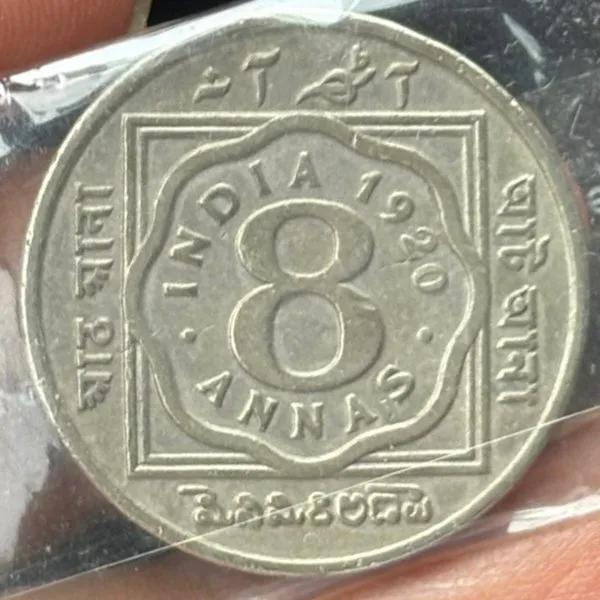
- Reverse: value in four scripts — Urdu, Bengali, Telugu and Devanagari — around a scalloped centre inside a double-lined square.
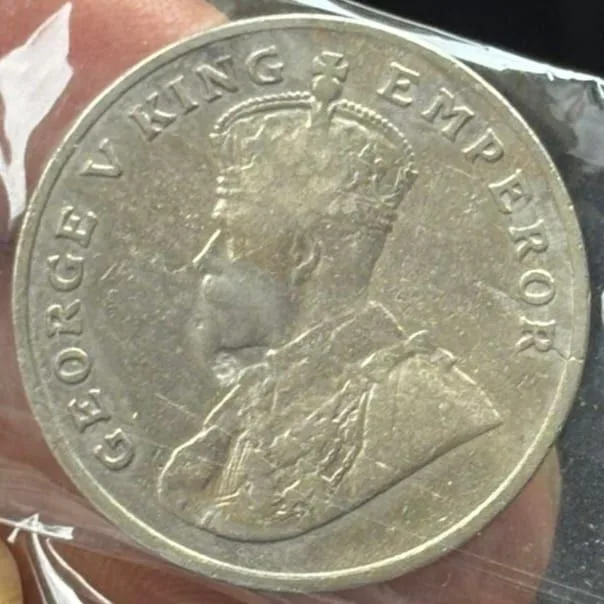
- Obverse: bust of George V facing left, legend GEORGE V KING EMPEROR, engraved by Edgar Bertram MacKennal.
- Mint mark: a small bead below the reverse design indicates Bombay. Calcutta pieces carry no mark.
The coin is catalogued as KM# 520.
Watch: the 8 Anna 1919–1920 explained
What an 8 Anna is worth
Condition decides almost everything. Circulated examples sit well below uncirculated ones, and certified high-grade 1920 pieces have reached several lakhs at international auction houses.
As a working range, a genuine 1920 trades between ₹50,000 and ₹1,20,000 depending on grade.
Beware the viral numbers. Posts claiming any old 8 Anna is worth crores are false. Real prices are set by date, mint, and above all condition.
Buy the 8 Anna 1920 on CoinBazzar
The exact coin photographed above. Checked before listing and backed by our authenticity guarantee.
If your British India collection is missing 1920, that is the piece to hunt. Genuine examples in collectable grade do not appear often, and the ones that do are usually spoken for quickly.